Genre: The Big Myth?
As I have been writing in genres I didn’t expect to recently (horror, erotica), I thought I would post about the thorny subject of genre itself. I have always thought that it is some kind of mythical beast, or maybe a set of beasts, put on earth to enslave us. Along with the idea of there being a literary ‘canon’, genre prescribes to us what we should and shouldn’t like. Some might find this a controversial idea I know. But we all love a bit of controversy don’t we?
The literary canon is the idea that somehow some writing is definably better than others. To me this is at best laughable and at worst arbitrary. Many will hate me for saying this but my example is Shakespeare. Now the plays of the bard are seen by many, if not most, as being the pinnacle of writing, especially of plays and use of the English language. They seem to be lauded by all and endless theses are written by lofty academics about them. The question is about how such claims are judged. Well it’s simple. We believe they are the best plays because we are told they are the best plays. Told by ‘experts’, who have decided it to be so for us.
There are many problems with this approach. Firstly it leads to elitism. The idea that some art is automatically better than others. The idea of ‘high art’ or ‘high culture’, as opposed to more populist ‘low culture’. For example: Is Shakespeare’s work actually better than the script of a soap opera? All art is subjectively judged. We are active beings; we can actually decide for ourselves whether we like something or not. I would argue that more people don’t like Shakespeare than do. Maybe that is something to do with how we were often put off by it at school!
To be fair none of this means I don’t think Shakespeare is good, I just don’t get why he is so highly regarded. Why is he thought to be the ‘best’ by so many people? We don’t even know for sure that he wrote those plays, although we do know that the influence of those plays is almost endless. For me Shakespeare is best appreciated in the theatre. There it comes alive. And how few people have actually done that?
However just because something is popular doesn’t make it necessarily good. We can all think of things we hate to watch, read or listen to that lots of others love. Soaps for example drive me to distraction, yet millions watch (Eastenders anyone?). Care to share any examples? Justin Bieber??
All of this leads into the idea of genre. Genre too is tainted with the ideas of the literary canon. All art is equal but some genres are more equal than others. ‘Literary’ fiction is the highest in the charts of worthiness. It must be a very very good book if it is listed for the booker prize or some other marketing tool masquerading as a contest. Many great books are not even considered for such prizes. For example Kim Stanley Robinson (highly regarded SF author) argued that Adam Roberts book ‘Yellow Blue Tibia’ should have won the 2009 booker prize. It wasn’t listed, probably because it was labelled as ‘Science Fiction’. Now, that book has science and fiction and even parodies science fiction in it. BUT it is about so much more than simply that! (Read it it’s great!)
Genres other than ‘literary’ fiction often are seen as less serious, which in turn means less good, less well written. Genres like ‘romance’, ‘chick lit’ (sic), ‘crime’ as well as ‘SciFi’, ‘fantasy’ and ‘horror’. It’s almost like we could put these labels into a league of worth; of merit? I wonder which would come bottom of the league? ‘Erotica’? ‘Thriller’? ‘Airport novel’? What do you think? Can you write that league?
I do realise that genres exist to aid the reader (consumer?) to wade their way through the billions of books and ebooks out there. To help them narrow down the search for that elusive ‘page turner’ that will change their lives. The canon too, I guess, gives us pointers to those ‘classic’ works which many, many of us have cherished and loved. It allows every new generation to marvel at them. But I wonder too, how many ‘classics’ were missed? How many amazing works linger on bookshelves unread, maybe because they were labelled badly; put in patronisingly misleading genres.
Some writers attempt to cross-over or subvert genres, Margaret Atwood for example often debates whether she should be labelled as an SF writer or not. Other ‘literary’ writers like Kashio Ishiguro (‘Never let me go’) and Cormac McCarthy (‘The Road’) cross over and write SciFi and get heaped praise for it. Both I thought were excellent books but that other SF writers had used the same subject material and ideas perhaps better previously, but have not been recognised to the same degree because they were ‘SF genre’ writers. Notice that both those books were made into Hollywood films.
For writers, it seems then that genres present us with problems. Maybe problems we don’t realise. This can come down to the question of whether we write for ourselves or whether we write for our ‘audience’. If it is that latter then we may be tempted to fit the stereotypes of the genre, play it safe in order to please the reader. Nothing wrong with that in itself and there are scores of books that do this, some of my writing included I would say. I started writing thinking I was writing for myself and automatically began to write in the genre I enjoy most (SF) and this was fine, but I did wonder if I was really writing ‘copies’ or versions of the books that influence me. Again nothing intrinsically wrong with that. To learn to write is to read, and we are all influenced by our favourite things. Plagiarism is unavoidable! (Just don’t get caught!).
I guess what I am trying to say, as usual badly, is that I am beginning to feel stifled by the idea of genre. Maybe I just think too much, but I find it stifling as a reader. When I go to book shop (which I love to do) I, out of habit, go straight to the SF section to hunt out a new page turning space opera. But in the last couple of years, without really realising it, I have come across two problems. Firstly the science fiction section is always lumped in with ‘fantasy’. Now don’t get me wrong, I can love a bit of fantasy, but there seems to be endless books that look the same. No offence to any fantasy writers and twitter friends who love this genre but it feels like we have endless retreads of Tolkien-type fantasy. This puts me off. Just like there are now endless twighlightesque vampire/teen/werewolf type things. Again no offence if that is your thing.
The second problem is that the same thing is happening in SF. Books seem to be repeating the same patterns and formulas that sell and some books feel like repeats to me. As with all capitalism the market dictates. Maybe I am just a grumpy old dinosaur?
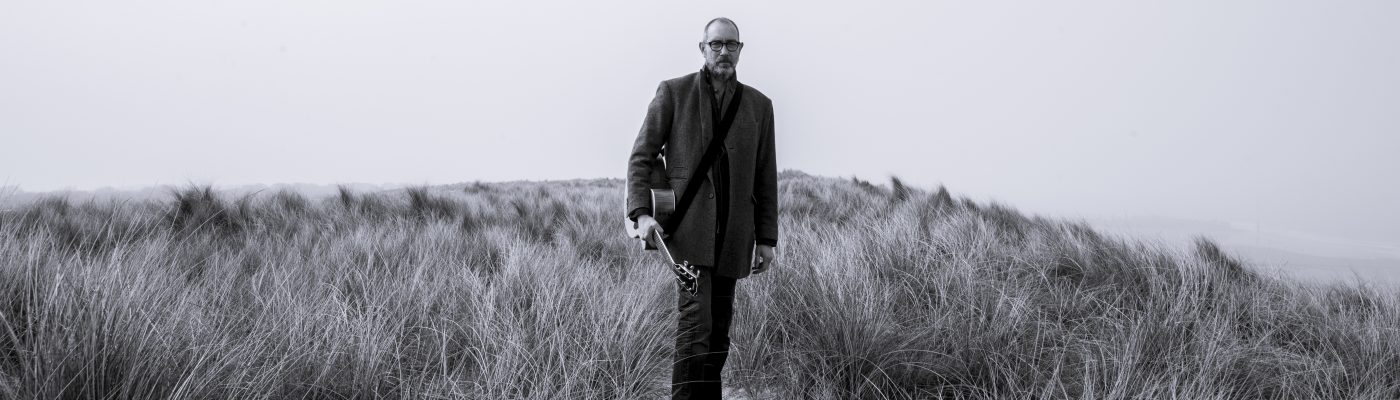
I guess you wonder where I am going with all of this? And as usual I am not sure. I am beginning to think I feel a bit stifled by genre as a writer to. It’s like when I tell people that I play guitar, sing and do gigs sometimes. The first question is always “What kind of music do you play?”, this would be easy to answer if I played covers of Bob Dylan, or something identifiable. But I play my own songs, so I never know how to answer this question. Even those who come to see me play find it hard to categorise. They might say “oh it’s kind of poppy, rocky music but that one was folky…err” They don’t know the genre, they just like the music. Shouldn’t writing and reading fiction be like that too?
Genres almost steer us away from that which we perceive to be ‘not for us’. I don’t like this. Genres trap us into reading and writing what we are told (even subconsciously) we should. I don’t like this. I am just a guilty as the rest of us. My reading and writing follows this safe pattern. I don’t like this. I still love my SciFi, always will…but…
So, what now? Well readers, I urge you to come out of your comfort zone! Read from any genre; forget genre. Challenge yourself to read things outside of your comfort zone. You will find untold treasures I am sure. And writers I urge you to do the same. Read outside of your chosen genre, this will undoubtedly influence your writing in a good way. Write outside of your chosen genre too, just for the hell of it. You never know, this maybe the way to writing a new classic. Worth a try! What do you think?
© 2011 Simon Poore
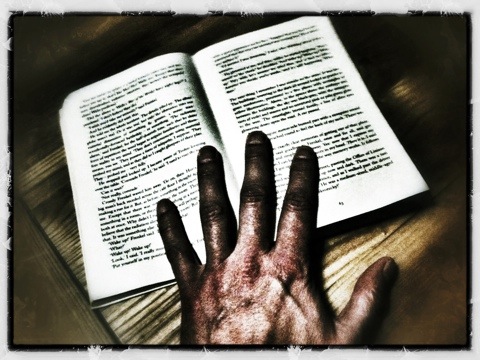
BLIMEY, that makes my hand look weird…
 simon tall