
Imagine, if you will, that you are in the corridor of an old fashioned plush hotel. The deep pile carpet feels warm nestled against your knees. You are breathing deeply but are unaware of this. The focus of your attention is the keyhole in front of you. Beyond the thick door is the object of your attention. A beautiful couple perhaps. Engaged in passion. Your ear, close to the grain of the door is devouring the soft sounds of their embrace. Your eyelash flicks the metal surround of the keyhole, its classic shape framing sections of the moving bodies, partially clothed, lost in passion, within the room.
Then, almost inevitably, you become aware of footsteps padding down the hallway…how do you feel in that moment?
This is my imagining of a scene suggested by the existentialist philosopher Jean-Paul Sartre in order to illustrate his view of self-awareness. The voyeur is completely unaware of his or her self whilst staring through the keyhole. Whatever their motive for taking the role of ‘Peeping Tom’ at that moment they are only conscious of of the object of their senses – the couple beyond the door.
The point being that they only become self-aware once they realise that they are the object of someone else’s gaze, the knowledge that someone else coming along the corridor can see them. And at that moment the voyeur will think of themselves in terms of what they perceive the other person will be thinking about them. They may think that the person in the corridor will be thinking that they are a ’peeping Tom’ or voyeur.
In a way what Sartre suggested was that we can never be truly self-aware. Our ’awareness’ can be a reflection of others.
In his book ’Being and Nothingness’ he says this:
“Consciousness is a being such that in its being, its being is in question, in so far as this being implies a being other than itself,”
The implication of this is that consciousness is dependent on awareness of an OBJECT. To be conscious you have to be aware OF something. When it comes to being conscious of the self, what happens is that we project a version of our ’self’ (the object) in order to be conscious of it and think about it. What this means is that the ’self’ we project and think about is not our true self but merely an image.
Often what happens when thinking of our ’self’ is that it is a reflection of what we think others think about us. Hence the voyeur thinks about the observer seeing them as a ’peeping tom’ and feels the associated guilt and shame. Before being observed the voyeur is not self aware at all.
So when we think about ourselves we generally tend to view it through a lens. We think that we are happy/sad/good/bad people because that is how others think of us.
When I think about this I realise how much of the time that we are not self-aware. How much of the time we are absorbed in something else. Like watching tv or reading a book. Even when we are engaged in an activity (me writing this for example), one can be thinking of other things on multiple levels, but not aware of anything around us.
I guess my question is whether we can ever truly ’know’ ourselves? I am not sure that we can because as humans we are continually moving and changing like shifting sands in the desert. The dunes of the sahara seem so large and full of form that they appear solid. The reality is that they are shifting waves; an ocean of sand sweeping ever so slowly, unseen, across North Africa. As people we are like these oceans of sand.
People often say ’it’s not in my nature’ to do this thing or that thing. Or they say ’I don’t have that kind of personality,’ or ’that person isn’t my type,’. As if the kind of person we are is somehow fixed in our DNA.
The truth is that I am not the same person I was yesterday, or last week, or ten years ago. If a boatbuilder repairs a wooden boat and replaces every single plank and mast and nail, is it the same boat? It has the same shape but surely a different essence.
What can we learn from this? I am not sure. Except to say that as humans we have choices and one of those choices is how we view the object that we project of our self in our minds. Too often we choose the negative view. If someone gives you five compliments and one throwaway negative comment (perhaps about how they don’t like your sweater) you go away remembering the bad thing. We should be mindful of this and when we think about ourselves attempt to keep the positive.
Sartre argued for an existentialist viewpoint. The only thing that exists is the here and now. The past is gone. Over. The future hasn’t arrived yet. There is only now. Right now. Therefore we can choose to interpret our past actions and feelings however we like. And we can choose what kind of person we think we are going to be in the future. Endless possibilities there!
Finally, back to the voyeur. If we are honest most of us should admit to being curious about what was beyond the keyhole. A glimpse of stocking perhaps? Can any of us truly say that we wouldn’t be tempted to look?
What do you think?

Hmm…what do you see? Is it a blur?
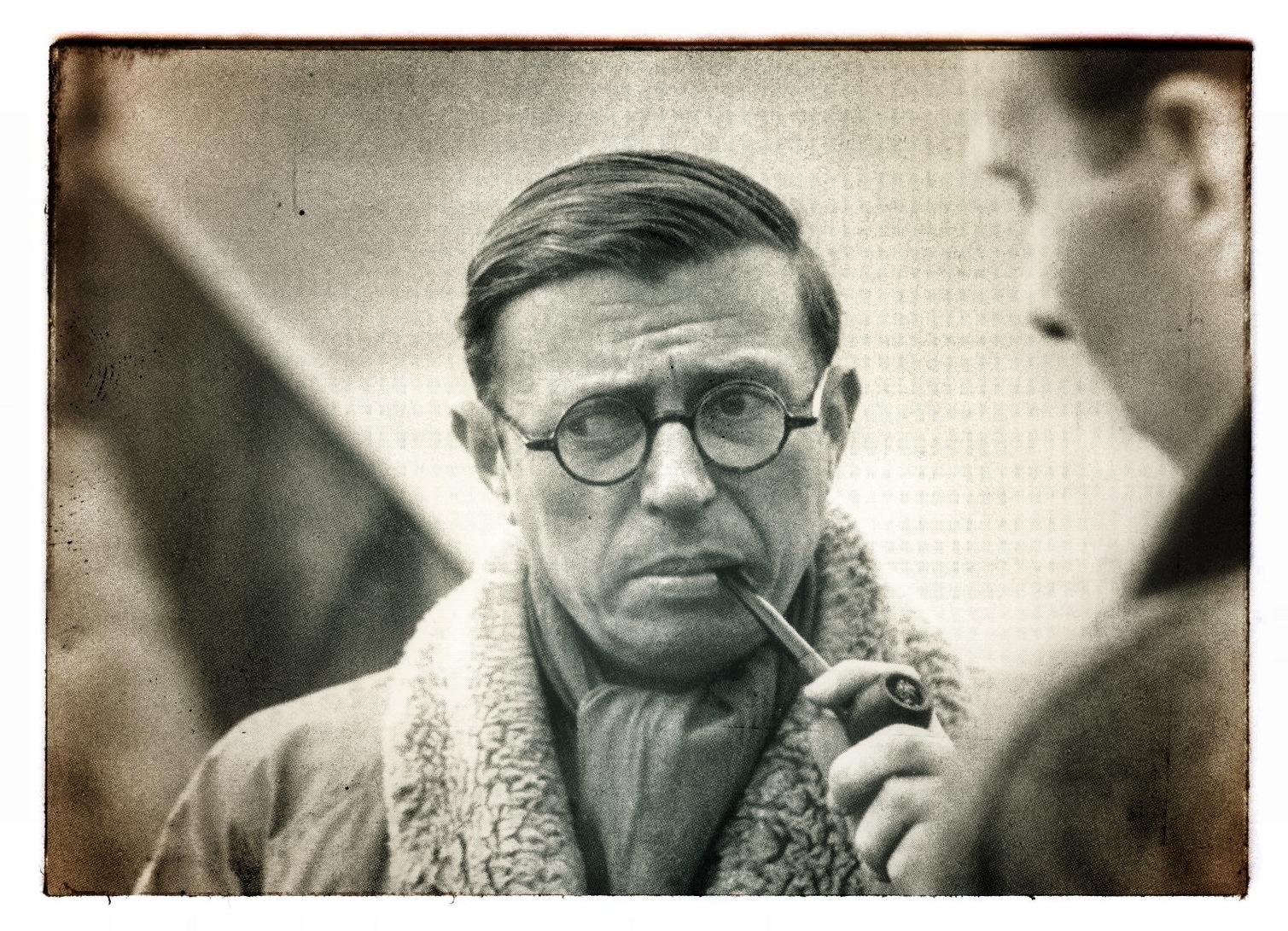
Jean-Paul Sartre – I wonder what he can see?

We are but shifting sands…
© 2013 Simon Poore

 simon tall