
Karl Marx. There is a name that conjures strong opinion. And whatever your opinions are it is undoubted that his thinking has had a major effect on the world for the last 150 years or so. For good or ill. At various points over the last century something like one third of the world’s population lived in states influenced by the Marxist ideas of socialism and communism.
Marx believed that people should be equal. He argued that eventually society would evolve to a state of communism where people would live equally. This would be a society with no ownership and no money. It would work by the principle of ‘to each according to need, from each according to ability’. In effect this would mean firstly that people would be provided for – all our needs would be provided for free; food, water, shelter, clothing and anything we need. Secondly it means that people would work at what they were good at, not for money, but for the satisfaction that they were helping others. A more altruistic, less selfish society would emerge.
I know there are lots of arguments about whether this is possible or even desirable but the problem I want to explore is how it may be possible that we get to this state of equality or communism or whatever you want to call it.
For Marx, getting there is problematic. His route firstly involves revolution (bloody or otherwise). Writing in the nineteenth century he predicted that workers would become so impoverished that they would rise up and overthrow the bosses who were exploiting them. The workers would then run things collectively for the benefit of everybody. This you could describe as socialism. Of course this didn’t happen in England, where he thought it would happen first, because this was where the industrial revolution was happening. His ideas did however influence revolutions in many other countries long after his death (Russia, China, Cuba etc).
Now the problem really comes with the transition from a socialist society, with ownership, money and where the state runs things on behalf of the people, to a truly communist one. In a truly communist one there would be no state, no government and things would be run communally and, as I have said there would be no money or ownership. Marx didn’t really explain how this transition would take place. It’s almost as if it would just evolve somehow by itself as people realised that it would be best.
And I would say at his point that such a society hasn’t happened. The nearest we have come, some argue, were the Kibbutz communes in Israel. On the scale of a nation it hasn’t ever happened. Don’t be fooled when people describe countries like China or Cuba or North Korea as ‘communist’; these countries are not. They may have ‘communist’ parties but at the very best they are socialist. At worst they are cruel dictatorships or oligarchies masquerading as communist in order to maintain power and privilege in the hands of the few (hang on…that sounds like capitalism…).
If you want to read a good fictional account of a communist world try ‘The Dispossessed’ by Ursula Le Guin. A damn good science fiction read.
Anyway, my question is whether a true communist society as Karl Marx described it is possible in reality? And if so how will we get there?
Well, I think the answer lies in a science fiction idea. Many of you will have encountered the idea of self-replicating machines. Scientists argue that future space exploration may be possible through self-replication. Imagine sending a spaceship out there that can mine resources from asteroids and make more spaceships.
On Star Trek they have replicators that can reassemble matter and make anything you desire, from a cup of ‘earl grey hot’ (Captain Picard’s favourite tipple) to component parts of a new shuttle craft.
Such machines seem far fetched but the beginnings of them are already here. For example there are computer controlled machines that have been built that can actually replicate themselves. Look up ‘RepRap’ machines on Google. Now these are not autonomous machines but they can replicate themselves and are pretty nifty 3d printers, where you can put plastic waste in one end and any shape you design comes out of the other.
Now imagine the future. Where machines collect all our waste and take it to other machines that recycle/reform those raw materials into anything we need. And all we have to do is ask them to. Machines could grow our food, transport us where we want to go, run the power stations and repair themselves. And these machines could make more machines to do all of this for us.
In this scenario us humans would not need jobs. We would not need money and everything would and could be provided for us. Capitalism would be over.
Now this idea has been used in science fiction for some time (check out the ‘culture’ novels of Iain M. Banks, for example).
It is not inconceivable that a society where machines do the work could well become a reality in some not too distant future. Some argue that we would become bored and our lives become meaningless. That we would have nothing to strive for. Perhaps we would be fat and lazy like those people on the spaceship in the animated film ‘Wall-E’.
But I like to think that human beings are more imaginative and intelligent than that. In such a future communist world of equality wouldn’t we be truly free to learn and create? Instead of selling most of our lives to someone else for the necessity of wages we could actually spend our lives pursuing the things we love…
What do you think?
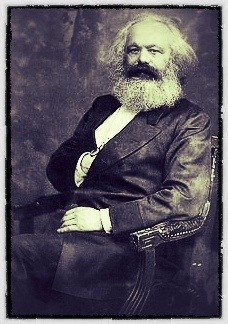
“Does my beard look big like this?”
© 2012 Simon Poore
 simon tall